The English universities in the 17th century
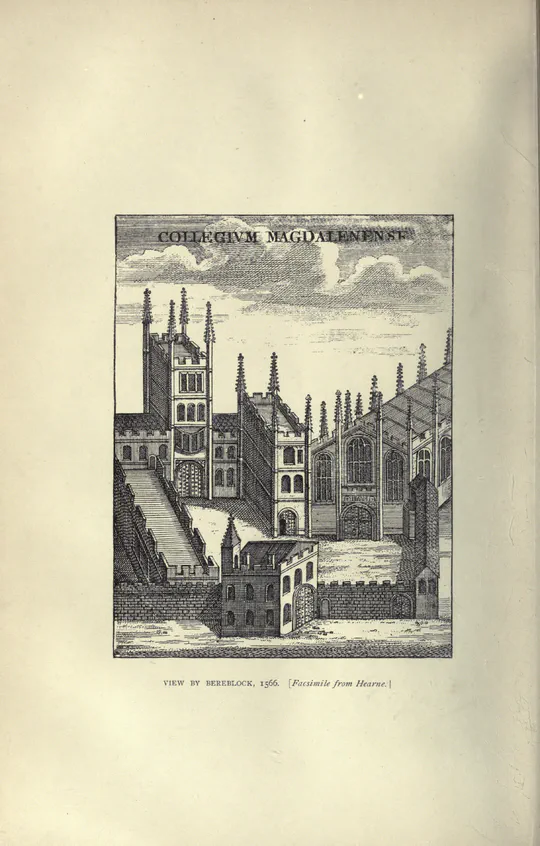
Picture: Magdalen College in 1566 from Foster’s Alumni Oxonienses.
Seventeenth-century universities stood at the intersection of medieval and modern regimes of knowledge production. On one hand, curricula remained largely rooted in scholastic and Aristotelian traditions—particularly in England. On the other hand, universities continued to serve as key sites of intellectual exchange. A central mechanism of this exchange was the vertical transmission of ideas between teachers and students.
In my paper “Teacher-directed change: The case of the English Scientific Revolution”, I argue that despite their traditionalism, the universities of Oxford and Cambridge played a critical role in passing on the ideas of the Scientific Revolution to a new generation of scholars.
You can find a short summary of the paper here (or just head to the paper itself):
“
”I’m happy to announce that my JMP🚨🚨Teacher-directed change: The case of the English Scientific Revolution” is now out as a working paper. Finalising the draft has been a lot of work. So, very happy to share this! For lots of history, new micro-data&natural experiments, read on pic.twitter.com/hTX2CKhj5C
— Julius Koschnick (@JuliusKoschnick) March 24, 2025
Or listen to this NotebookLM podcast here:

I am an Assistant Professor and Marie Curie Fellow at the Department of Economics at the University of Southern Denmark (SDU), part of the Danish Institute for Advanced Study (DIAS) and the Historical Economics and Development Group (HEDG).
My research interests include long-run growth, human capital formation, knowledge transmission, and natural language processing.